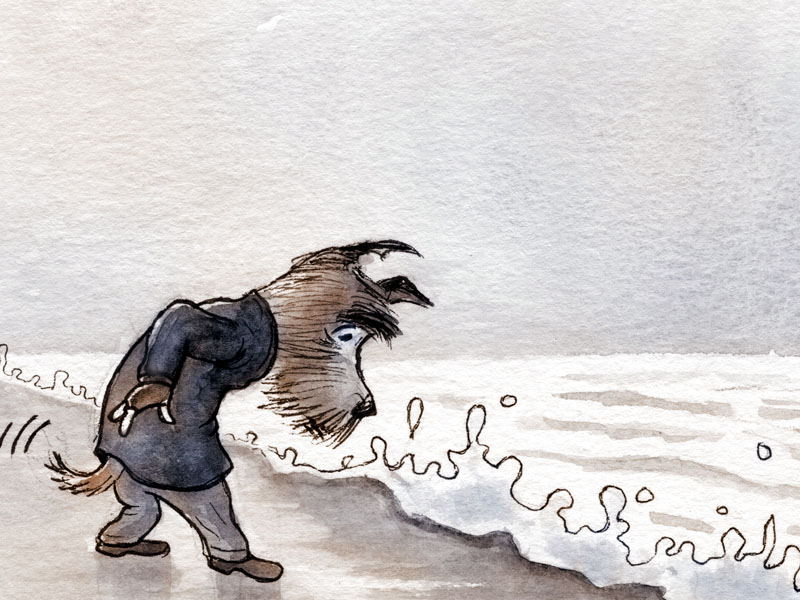
On the lonely road two outcasts meet -- spitfire Doris and a genteel, shell-shocked dog. Each of this unlikely pair harbors heavy grief and must decide whether to stay with their pain or run from it. Their journey takes them through wild and empty lands, an eerily abandoned town of echoes, and out to "Mudder Sea", a mysterious realm of visions all-too-clear.
Malkasian's graphic novels are known for their layered metaphor, and
Shadows of the Sea is no exception, with darkness itself a character, bearing the weight of unbearable truths.
Reviews of Shadows of the Sea
shelfawareness.com
Animation director and cartoonist Cathy Malkasian's powerfully poignant Shadows of the Sea brings together two gentle, suffering strangers who create a healing community of found family. Stanwick, aka Landmine Sniffer Dog #336, has been dismissed with a mere letter and wad of cash. While paused in his aimless wandering to adjust his prosthetic leg, he smells serious trouble: three sore losers viciously attacking a woman for prizes not theirs. Stanwick strategically intervenes, intertwining his future with hers.
Their journey commences, through forests, rivers, and winding paths, and lands the pair in an abandoned town. Along the way, Doris chatters--about a mother who cursed her, working as a "vermin hunter" then "in puhtatuhs," recalling her "fella Ralph." Stanwick's silence doesn't mean he's incommunicative; he saves Doris from poisonous berries, laughs at her bad jokes, assuages her hunger. But both carry debilitating grief from their pasts, literally manifested into burdensome shadows ready to subsume them. But "tuh mudder sea... wash dere shadduhs clean," allowing woman and dog to bear witness to their respective tragedies and finally let (enough of) the sadness go. Finding themselves in an abandoned seaside village, the duo is ready to chance renewed beginnings.
Malkasian creates warmly inviting panels in earthy watercolor shades of browns and blues. Her characters--particularly the kind ones--are gorgeously expressive, a head tilt, raised eyebrow, faraway gaze affectingly capturing every emotion. The left-behind empty town is an architectural marvel, seemingly carved into mountainous stone, magically landscaped, ready for new life. Doris envisions "good peoples will come from near an' far"; good readers will surely appreciate and remember their visits.
--Terry Hong
retrofuturista.com
Cathy Malkasian combines whimsical elements with themes of profound sadness in her graphic novels. With her latest release, Shadows of the Sea, published by Fantagraphics, Malkasian delivers a stunningly painted allegory that feels both timeless and sharply relevant to our current moment.
Set against a backdrop of misty coastlines and abandoned architectural marvels, Shadows of the Sea is a story about those left behind by a society obsessed with “higher” pursuits. It is a tale of unlikely friendship, the dignity of labor, and the quiet beauty of the earth that remains when the ambitious have fled.
The story opens by introducing our protagonist, a schnauzer wearing a suit, who has just been made redundant. He is “Landmine Sniffer Dog #336” for the “All Mines Corporation.”
In a biting satire of corporate restructuring, the dog receives a “Dismissal with Honors Notice.” The corporation is pivoting from landmine detection to a more lucrative “Drug Sniffing Division,” and the dog is cast out with a cash severance and a binding NDA. This cynical start sets the tone: utility is valued over loyalty, and profit dictates survival.
Wandering the coast, the dog encounters Doris, a “fish gutter”, specifically, a county-wide gutting champion for ten years running. She is physically sturdy, rough-spoken, and deeply connected to the sea, referring to it affectionately as “Mother Sea.”
Their paths cross when Doris is robbed by a trio of bullies, Tom, Roy, and Eddie, who steal her prize medals and, most crucially, her sharpening stone, a wedding gift to her husband, Ralph.
As the duo pursues the recovery of Doris’s stolen items, they reach a “fancy town” left eerily silent, its architecture displaying biomorphic and surreal forms. Its former wealthy inhabitants, the “fancy folk,” believed the world was ending on the Solstice. In a bizarre twist of mass delusion and elitism, they divined the planet’s “hurl point” and collectively left. They intended to dwell with the stars, literally looking down upon those they deemed lesser, calling the world they left behind a “dung heap.”
While the elite fled, they left behind vast stores of food, beautiful architecture, and natural hot springs. Malkasian brilliantly contrasts the absurdity of their exodus with the pragmatism of the dog and Doris. While the rich looked up to the stars, Doris and the dog looked around, realizing that the world is still beautiful, functional, and now, theirs to reclaim.
Malkasian uses soft pencils and lush watercolors, creating a world that feels damp, heavy, and textured. You can almost feel the cold mist of the sea and the roughness of the ancient stone steps.
The character designs are expressive and often exaggerate physical traits to reflect personality; the dog’s weary, soulful eyes contrast sharply with the grotesque, exaggerated features of the bullies or the stoic, solid presence of Doris.
Shadows of the Sea questions the value of “escaping” reality versus the bravery of inhabiting it. For readers who appreciate the works of Shaun Tan or Raymond Briggs, Malkasian’s latest offers a rich, immersive experience that lingers long after the final page is turned.
As Doris suggests near the end, perhaps the “fools” are the ones who left, leaving behind a world with “such good bread in it.”
cinemasentries.com
A chance meeting of two grief-stricken social outcasts leads to a healing journey and hope for a new future. Cathy Malkasian’s latest graphic novel deals with heavy themes including despair and isolation, and is rendered in subdued, gloomy earth tones, and yet is crafted with such masterful skill that the end result is positively uplifting.
We’re first introduced to Stanwick, a feeble anthropomorphic dog casting about for direction in the wake of a tragic and career-ending accident. When he encounters a group of thugs harassing a small but feisty woman named Doris, he attempts to help her from afar and subsequently approaches her after the scuffle. He’s seemingly mute, but Doris is very chatty, making her the de facto narrator as she attempts to guess his story and describes their joint wanderings into unknown territory.
Malkasian makes unlikely stars out of a handicapped old dog and a stout middle-aged woman commonly disparaged as a troll. Their chance meeting and subsequent joining of forces feels organic and genuine, even before we have any inkling of their sad back stories. The unlikely duo wander through an abandoned town before reaching the sea, where the weight of their emotional burdens physically manifests as shadows attempting to drag each of them into the sea.
It’s only when the accumulated grief of their shadows enters the cleansing, healing sea that we finally discover the origin of their pain. Their stories play out in visuals projected over the sea by their shadows, allowing each character to fully face their trauma, share it with their new partner, and finally start to heal. Rich in allegory and heartfelt emotion, the book is a rewarding puzzle inviting readers to explore its fascinating premise.
Malkasian’s artwork is shaded with lush, somber watercolors matching the downbeat mood of the characters, but the line work is so crisply defined that it effortlessly cuts through the gloomy hues. While most of the story transpires in the great outdoors of the countryside, the architecture of the abandoned town reveals vast scale and whimsical detail that feels akin to Jim Woodring’s fanciful approach to construction. Malkasian also pays special attention to conveying Doris’s state through her facial expressions, driving home the full extent of the character’s emotional journey. It’s an artistic tour de force that greatly enhances the already intriguing plot.
Malkasian has once again created a stunningly original and wholly involving tale. Readers are guaranteed to connect with Stanwick and Doris, making this a buoyant quest of discovery and emotional engagement.
--Steve Geise
midwestbookreview.com
Original, engaging, deftly crafted, "Shadows of the Sea" by storyteller and illustrator Cathy Malkasian is an extraordinary, compelling, and simply fascinating read from start to finish. A masterpiece of graphic novel storytelling, "Shadows of the Sea" is unreservedly recommended for personal, community, and college/university library Graphic Novel collections. It should be noted for fantasy graphic novel fans that this hardcover edition of "Shadows of the Sea" is also readily available from Fantagraphics in a digital book format.
comicsbeat.com
Cathy Malkasian’s Shadows of the Sea tells an intimate story of grief and healing set in a fantastic world that follows its own logic yet remains intriguingly strange.
A small but handsomely suited terrier named Stanwick, referred to as “Landmine Sniffer Dog #336” in his corporate dismissal letter, has recently found himself unemployed after losing his leg in an accident. While wandering along a deserted mountain road, he witnesses a troubling tableau. A fierce and frizzy-haired woman defends herself from three thugs, who flee in terror after being thoroughly trounced. Stanwick approaches the woman, who introduces herself as Doris and informs him that she’s on a journey to find a new pocketwatch for her husband.
With little else to do, Stanwick accompanies Doris as they continue through the forested hills and traverse a fantastic abandoned city carved into a mountain before descending to a hidden cove, where the waiting ocean summons unpleasant memories they’ve been at pains to ignore.
Doris has been lying to herself about the watch she wants to buy for her husband. Though her love for a man who provided her with a home and a purpose is real and good, Doris’s difficult childhood has given her a history of repressing bad memories, and the stories she tells herself about her past are more fiction than reality.
Stanwick, who has been denied his livelihood and purpose by a sinister corporation that blithely punished him for doing his job, has painful memories of his own. Even worse, his shock from the accident that took his leg is still so strong that he’s unable to speak.
Before Stanwick and Doris can make it to the other side of their grief, they must first confront the sources of their trauma, but their path is anything but straightforward. Despite Doris’s infectious energy and Stanwick’s quiet competence, Shadows of the Sea takes its time to arrive at a resolution. The story allows the atmosphere of grief to linger, stretched out like the long and empty roads Doris and Stanwick follow on their way to the ocean.
Cathy Malkasian’s distinctively stylized artwork invites the reader to inhabit the emotional weight of the journey. The distortions in the visuals reflect the inner turmoil of the characters, and the disquieting landscapes underscore the severity of their past experiences. The limited color palette sets the mood for a surreal blending of the characters’ interior and exterior worlds in a powerful climactic scene. After Doris and Stanwick return from their ordeal, however, the blues and browns of their world transform into the refreshing colors of the sky after a storm.
In his review here on The Beat, John Seven assesses Malkasian’s 2017 graphic novel Eartha as one of the artist’s characteristic “gloomy, apocalyptic parables that don’t make you feel so great about humankind.” It’s difficult to disagree, as Eartha is deeply disquieting. In contrast, Shadows of the Sea feels like a gentler turn of the same thematic wheel, presenting a story that’s smaller in scope but richer in emotional immediacy.
Stanwick’s quiet fortitude and Doris’s unruly vitality form a compelling pairing, and their companionship serves as a steady thread guiding the narrative away from desolation and toward renewal. The fantastic world Malkasian has painted is cruel and strange, to be sure, but it still affords the possibility of healing. Shadows of the Sea lingers not because of its darkness, but because of the hope that emerges after a brave confrontation with bitter truths.
-- Kathryn Hemmann